Canada’s labour market is entering a new phase.
After several years of intense competition for talent, rising wages and widespread hiring challenges, the market is becoming more selective. Employers are taking a closer look at where they invest in talent, while candidates face greater competition and higher expectations around skills, adaptability and performance.
As we look toward 2027, success will depend less on simply filling or securing a position and more on having the capabilities to create meaningful value as business needs change.
For employers, that means defining more precisely what each hire needs to accomplish. For professionals, it means demonstrating not only experience, but also adaptability, commercial understanding, technological fluency and measurable impact.
So, what has changed in Canada’s labour market, and what should employers and candidates be doing now to prepare for 2027?
What Is Changing in Canada’s Labour Market for 2027?
- Canada’s hiring market is becoming more selective.
- Employers may have more applicants overall, but specialized skills remain difficult to find.
- Economic uncertainty is making companies more cautious about adding headcount.
- AI is changing how work is done across functions, not just in technology.
- Skills, adaptability and business impact are becoming more important than job titles alone.
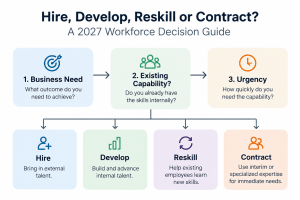
- Workforce planning increasingly needs to consider hiring, development, reskilling and workforce redesign together.
1. Canada’s Hiring Market Is More Competitive and Less Predictable
The days of a universally tight labour market are behind us, at least for now.
Cana2da’s unemployment rate was 6.4% in August 2026, while Ontario’s was 6.9%. In July 2026, there were approximately 501,000 job vacancies nationally, with 2.9 unemployed people for every vacancy.
That gives employers more choice than during the tightest parts of the labour market, but it does not mean the right talent is easy to find.
The market is increasingly segmented. Some organizations are slowing hiring or restructuring, while others continue to compete for specialized expertise, leadership capability and critical technical skills.
What should hiring managers do
- Define the business outcome first. Before launching a search, ask:
What business problem does this position need to solve?
A clear answer makes it easier to distinguish essential capabilities from requirements that have simply carried forward from an old job description.
- Look beyond the obvious candidate profile. Consider candidates with:
- Transferable skills
- Adjacent industry experience
- Non-linear career paths
- Strong learning ability
- The potential to grow into parts of the position
- Move quickly when the right candidate emerges. A more selective labour market does not eliminate competition for exceptional candidates.
Long interview gaps, unclear decision-making and unnecessary stages can still result in losing someone your organization wants to hire.
Related resource: Toronto Recruiters
What should candidates and employees do
- Expect greater competition. A strong resume alone may not be enough. Employers increasingly want evidence of:
- Problems solved
- Results achieved
- Skills developed
- Business impact
- Adaptability
- Explain your value clearly. Focus on problems solved, outcomes delivered and measurable impact. The stronger your evidence, the easier it is for an employer to understand the value you could create.
- Stay open to adjacent opportunities. Your next move may come from a different industry, role structure or business model.
2. Economic Uncertainty Is Reshaping Workforce Decisions
Trade tensions, economic uncertainty and changing business conditions are influencing how Canadian organizations approach growth and investment.
For employers, this is creating a greater emphasis on productivity, profitability and workforce flexibility. Hiring decisions are increasingly being evaluated through the lens of business impact.
What should hiring managers do
- Connect Every Hire to a Business Priority. Start with the outcome the role needs to support, such as:
- Revenue growth
- Customer retention
- Cost control
- Operational efficiency
- Transformation
- Risk management
- Succession
- Market expansion
- Hire for the Capability You Need. A vacancy does not always need to be replaced like-for-like. It may be an opportunity to add a different capability.
For example, replacing a finance leader could be a chance to strengthen FP&A, business partnering, systems or transformation expertise.
- Keep Workforce Planning Flexible. External recruitment should sit alongside:
- Internal development
- Succession planning
- Redeployment
- Upskilling and reskilling
- Contract or interim support
What should candidates and employees do
- Develop commercial acumen. Understand how your role connects to revenue, costs, productivity, customer experience and overall business performance.
- Demonstrate measurable impact. Go beyond responsibilities and be ready to explain the results, improvements or value your contributions created.
- Think beyond your job description. Professionals who understand the broader business can identify problems and contribute more strategically.
3. AI Is Changing the Nature of Work and the Skills Employers Value
Artificial intelligence is changing conversations about productivity, skills and the future of work.
Statistics Canada’s early research found that employment generally grew across occupations with different levels of potential generative AI exposure between November 2022 and December 2025. However, younger workers and those with less education experienced weaker employment growth overall.
What should hiring managers do
- Hire for adaptability as well as experience. Look for candidates who can:
- Learn unfamiliar tools
- Question inefficient processes
- Apply technology practically
- Navigate ambiguity
- Translate technology into a business result
- Redesign work before simply adding technology. Identify where AI can improve productivity, decision-making and service delivery.
- Invest in upskilling existing employees. The answer to every AI-related capability gap will not be recruitment. Upskilling and reskilling existing employees may be just as important.
- Balance technical capability with human judgment. Skills such as:
- Critical thinking
- Communication
- Leadership
- Relationship-building
- Creativity
- Judgment
can become more, not less, important as routine work becomes more automated.
What should candidates and employees do
- Understand how AI is affecting your profession.
- Show how you have used technology to solve problems or improve results.
- Strengthen judgement, communication and problem-solving alongside technical fluency.
- Continue developing as tools and expectations change.
How Are AI Skills Changing Hiring?
Gary Hinde, IQ PARTNERS Technology Recruiter:
“Employers are hiring for both. AI is becoming increasingly prevalent in the applications we use in both our personal and professional lives, and knowing how to get the most out of this technology is becoming an expectation rather than a nice-to-have.
At the same time, employers are looking for candidates who can develop AI functionality within new and existing applications.”
4. Early Career Talent Is Facing a More Difficult Entry Point
One of the most important labour-market developments is the challenge facing younger workers.
The Bank of Canada has highlighted weak hiring, less job switching, rising long-term unemployment, with younger workers particularly affected.
This creates a long-term challenge for employers as well as candidates.
Organizations need to develop future leaders, build succession pipelines and ensure they have the capabilities required for long-term growth. Yet, when hiring slows, entry-level opportunities and pathways to gain experience can become more limited.
What should hiring managers do
- Don’t overlook emerging talent. If every role requires several years of direct experience, organizations can unintentionally eliminate the pipeline that creates experienced candidates in the first place.
- Create meaningful development pathways. Consider:
- Internships
- Mentorship
- Graduate programs
- Structured onboarding
- Stretch assignments
- Rotational opportunities
- Assess potential alongside experience. Curiosity, learning agility, initiative and problem-solving can be powerful indicators of future contribution.
What should candidates and employees do
- Build practical experience through internships, projects, certifications or volunteer work.
- Develop skills relevant to the roles and industries you want to enter.
- Build professional relationships before you urgently need them.

5. Skills and Adaptability Are Becoming More Important Than Titles
As organizations reconsider how work gets done, traditional titles and career paths do not always tell employers enough about whether someone will succeed.
The most valuable professionals may not necessarily have the longest resumes or the most impressive titles. They may be the people who can adapt, collaborate across functions, solve problems and translate expertise into meaningful business outcomes.
What should hiring managers do
- Hire for capability, not credentials alone. Assess:
- What has the candidate actually done?
- In what environment?
- Under what constraints?
- What changed because of their contribution?
- Can that experience translate to your organization?
- Develop leaders who can navigate change. Leadership in 2027 will continue to require:
- Strategic thinking
- Emotional intelligence
- Communication
- Decision-making
- Team development
- Adaptability
- Build a culture of continuous improvement. Encourage employees to challenge assumptions, share ideas and develop new capabilities.
- Think beyond today’s vacancy. Consider how a candidate fits the organization’s:
- Long-term capability needs
- Leadership pipeline
- Succession plan
- Growth strategy
What should candidates and employees do
- Think in terms of skills, not just titles. Identify the capabilities you’ve developed and how they can translate into new opportunities.
- Demonstrate leadership at every level. Taking initiative, supporting colleagues and solving problems are ways to show leadership before receiving a formal title.
- Invest in your professional reputation. Results, reliability, relationships and expertise all contribute to how employers and peers perceive your value.
How Can Employers and Professionals Prepare for 2027?
The labour market will continue to be shaped by economic conditions, technology, investment and changing business priorities.
The exact direction is difficult to predict, but both organizations and professionals can prepare.
For organizations: Build a workforce that can adapt and deliver
The most important question is not:
“Who do we need to hire?”
It is:
“What capabilities will our business need to succeed, and how do we build them?”
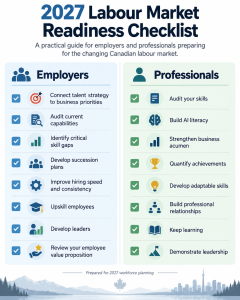
Focus on six areas:
- Align talent strategy with business strategy.
- Identify future skill gaps and succession risks.
- Make hiring more intentional.
- Develop leaders who can manage change.
- Build continuous learning into the organization.
- Strengthen the employee value proposition.
For candidates and employees: Become the professional businesses need next
The key question is not simply:
“What is my next job?”
It is:
“How can I continue to create value as work changes?”
Focus on:
- Assessing your skills honestly.
- Building AI and digital fluency.
- Strengthening business acumen.
- Making your accomplishments visible.
- Developing your professional network.
- Taking ownership of your development.
Relevance Is Something We Build
Canada’s labour market is changing, and expectations are changing with it.
For employers, the challenge is to build teams that can deliver today while developing the capabilities required for tomorrow.
For professionals, the challenge is to remain adaptable, curious and focused on creating meaningful value.
The organizations and professionals most prepared for 2027 will be those that treat talent as a strategic investment requiring intentional hiring, continuous development and a willingness to evolve.
At IQ PARTNERS, recruitment is about more than filling an open position. It is about understanding what an organization needs to accomplish and connecting the right people with the right opportunities.
Preparing for your 2027 hiring needs?
Discuss Your Hiring Needs | Find a Specialist Recruiter
Frequently Asked Questions
What types of roles are likely to change the most by 2027?
Roles involving repeatable analysis, administration, reporting or content production may experience significant task-level changes as AI and automation become more common. That does not necessarily mean the roles disappear. In many cases, work will shift toward judgement, interpretation, problem-solving and stakeholder management.
Should companies rewrite job descriptions for 2027?
In many cases, yes. Job descriptions should reflect the outcomes, skills and responsibilities the business needs now rather than automatically reusing an older version of the position. This is especially important when technology, team structures or business priorities have changed.
How can employers identify transferable skills in candidates?
Look beyond industry labels and job titles. Focus on the problems the candidate has solved, the environments they have worked in, the decisions they have made and the outcomes they have delivered. Skills such as analysis, leadership, communication, change management and stakeholder influence can often transfer across sectors.
How can organizations measure whether their workforce is ready for 2027?
Start by reviewing current capabilities against future business priorities. Look at succession risk, hard-to-fill roles, emerging skill needs, leadership depth, technology adoption and development opportunities. The goal is to understand which capabilities should be hired externally and which can be built internally.